
Automated chart retrieval cut record turnaround time in half
How AmeriHealth Caritas, two North Carolina health systems, and Moxe replaced manual medical record requests with automated, EHR-direct data exchange for HEDIS® reporting.

The KLAS study at a glance
Payer: AmeriHealth Caritas, Pennsylvania, 2 million members
Providers: Provider A, North Carolina, 800 locations and 1,900 physicians | Provider B, North Carolina, 300 primary care and specialty locations, 2,700 physicians
Technology partner: Moxe, Wisconsin, Interoperability and value-based care
The problem: AmeriHealth Caritas retrieved clinical data by hand delaying or hindering quality improvement work
What the collaboration achieved
Providers stopped fielding repeat chart requests. The payer got cleaner, faster clinical data.
50% Faster turnaround on record releases
Provider A cut its release time in half once record delivery started running on a regular schedule.
164,000 Charts delivered with no added cost or staff
122,000 charts from Organization 5-1 and 42,000 from Organization 5-2, without either provider allocating resources.
2% to 7% Improvement in care gap closure rates
AmeriHealth Caritas saw this gain over 9 months, along with better tracking and trending of HEDIS data.
The challenge on both sides
Payers need timely, accurate clinical data to close care gaps and meet HEDIS® deadlines. Providers need to keep up with release of information requests that all arrive at the same time of year. The old process was failing both.
Requestor: Slow, incomplete clinical data
AmeriHealth Caritas retrieved clinical data by hand. The process was cumbersome and time consuming, and it often produced delayed or incomplete medical records that held back quality improvement work.
Providers: HIM teams buried in requests
To hit HEDIS deadlines, payers often request the same patients’ charts more than once, in different formats for different regulations. Both health systems felt overwhelmed every season.
One payer alone sometimes sent more than 128,000 medical record requests.
How Moxe automated release of information
Moxe connected directly to the providers’ EHRs through an API that respects data release restrictions. The same transfer process works across EHRs, so every site follows one consistent path.
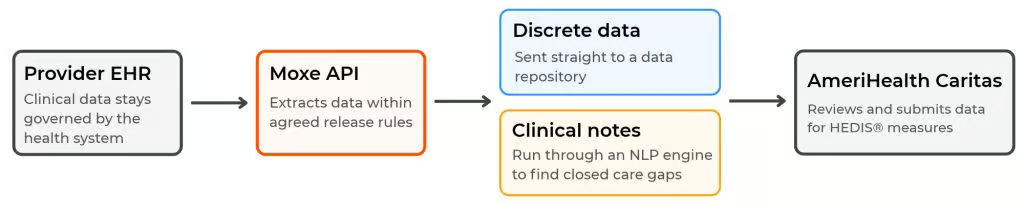
A careful pilot first. AmeriHealth Caritas piloted the exchange with Healthcare Organization 5-1 to see how much data was coming in and what it looked like. The payer spent a couple of weeks testing the incoming data, while the health system monitored what left its system to confirm it met agreed standards.
Weekly meetings and on-site walkthroughs. Every stakeholder brought their technical resources to the table, aligned on the cadence of data sharing, and stayed willing to pivot as the process improved.
Lessons other organizations can use
Plan around each organization’s needs
The team defined data specifications early and decided how data would reach each site, so sharing stayed private, precise, and transparent.
Build leadership expectations on trust
Trusting relationships take time and depend on every stakeholder staying accountable and agile.
Audit the data
The provider organizations regularly check data dashboards to confirm the payer follows its contracts.


Ready to discuss if Moxe is a fit for your needs?
Book a short call with one of our experts to get started.