
Three audits. One chart. Too many requests.
The cost of asking providers for the same record three times
Picture a mid-sized primary care provider in the spring. In the same few weeks, a nurse on a health plan’s quality team asks for charts to close HEDIS gaps. A coding team from the same plan wants records for risk adjustment. And a payment integrity reviewer needs documentation for a claim audit. Some of these requests involve the same patient, the same visit, and the same chart.
The provider responds to each one separately, in a different format, through a different channel, on a different deadline. From the provider’s side, it is one plan asking for the same thing three times. From the plan’s side, it is three departments doing their jobs.
How the duplication happens
This is rarely a failure of any one team. It is a byproduct of how plans are organized.
Risk adjustment runs on CMS deadlines. Quality teams work around HEDIS reporting cycles. Payment integrity runs year-round, driven by audit schedules and recovery windows. Each function has its own budget, its own vendors, its own timelines, and its own definition of a complete record. Nobody is asking providers for the same chart on purpose. There just isn’t a shared view of who has already asked for what.
The result is that the same provider network gets contacted repeatedly, and the plan pays repeatedly for retrieval work that overlaps. Streamlining this request process means providers can have one point of contact for all request types.
“We have multiple teams doing similar work. Moxe has been helping us solve some of those challenges by standardizing the work. If we did it internally on our own, multiple teams would have multiple points of contact. But with Moxe we’re able able to have one point of contact [with payers].” – Wil Limp, MS, RHIA, FAHIMA
What it costs
The cost shows up in three places.
Provider time. Manually fulfilling a single chart request can take 10 to 12 minutes. That is small for one chart and large across thousands. Multiply it by overlapping requests and the burden lands on the clinical and administrative staff who would otherwise be supporting patient care.
“By automating chart requests for HEDIS and MRA, Moxe helped us save time, reduce costs, and regain our focus on patient care.” Hannah Sorgius, HIM Director, Atrium Health
Plan spend. Every duplicated retrieval is paid for twice, through internal staff time, vendor fees, or both. Because the work is split across departments, the total rarely appears on any single budget line.
“With our partnership with Moxe, a list of over 17,000 requests was done within a week. That’s a big win for us, this newfound speed and efficiency have been transformative.” North Carolina based regional health plan. “Moxe’s commitment to transparency makes our partnership successful. We are not left wondering and requesting status updates on requests.”
Provider goodwill. This is the hardest to measure and probably the most important. Payment integrity in particular depends on provider cooperation. A provider that feels overburdened is slower to respond, more likely to dispute findings, and less receptive to the next request. One regional health plan told us that more efficient and secure data sharing strengthened its provider relationships, because providers could trust that sharing was timely and limited to only what was requested.
What a unified approach looks like
A unified clinical data request strategy does not mean merging risk adjustment, quality, and payment integrity into one team. It means giving them a shared way to ask. In practice, that tends to involve four things:
- A shared inventory of requests. Knowing which providers are being asked for what, by whom, and when. Many plans have never put this on one page.
- A common front door. One coordinated channel to providers instead of several independent ones, so practices see consistent, predictable requests.
- Reuse where it is appropriate. If a chart has already been retrieved for one permitted purpose, the plan should know that before asking again. This takes careful governance, since each use case has its own purpose and its own minimum necessary considerations, and compliance teams should define the rules.
- Consistent formats and status visibility. When delivery formats are standardized and every team can see the status of a request, fewer follow-ups and reconciliations are needed.
Why this is hard (and why it is still worth doing)
It would be dishonest to pretend this is simple. The three use cases do not need identical data. Risk adjustment cares about specific encounter types and documentation of conditions. HEDIS looks for particular clinical elements. A payment integrity audit may need the full record around a specific date of service. A unified strategy has to respect those differences rather than flatten them.
Ownership is also a real obstacle. A coordinated approach asks several leaders to share a process that each currently controls, and it asks finance to look at spend that sits in several places. Those are organizational questions, not technical ones.
Technology is part of what has changed, though. Standards-based exchange gives plans a way to reach many practices through a single connection rather than building a one-off path for each. In a recent initiative with a national payer and an ambulatory EHR vendor, the payer submitted a complete chase list across the entire connected provider network at once, instead of working through requests sequentially.
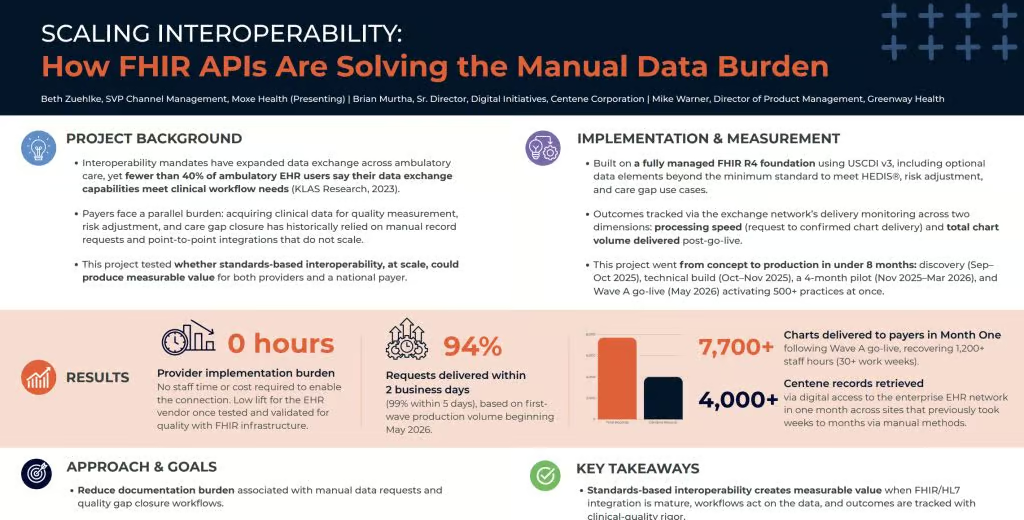
In its first month, more than 7,700 charts were delivered and an estimated 1,200 staff hours were recovered. Those results came from quality and risk adjustment use cases, but the underlying point applies to payment integrity as well: when the connection to the provider is built once, every team that needs it benefits.
Where to start
Plans do not need a multi-year transformation to make progress. A few practical first steps:
- Count the requests. Pick ten high-volume providers and tally how many chart requests they receive from your organization, across all teams and vendors. The number is often a surprise.
- Map the overlap. Look at where the same members, practices, or time periods show up in more than one workflow.
- Evaluate vendors. Understand which vendors provide access to your highest volume providers.
- Pilot with one provider group. Coordinate requests for a single large group across two departments, and measure turnaround and provider feedback.
- Name an owner. Even a cross-functional working group with a clear lead is better than no one owning the whole picture.
The takeaway
Plans have spent years getting better at deciding what to ask for. The next gain may come from improving how, and how often, they ask. A provider who gets one clear, well-coordinated request is more likely to respond quickly, and a risk adjustment team with faster, fuller records is better positioned to find, support, and recover what it should.
If this information has resonated with you and you are interested in streamlining your requests across teams, you can speak to our experts at any time by simply requesting a meeting.