
2026 Guide to Release of Information (ROI) & Compliance
Introduction to ROI | HIPAA, HITECH, and Beyond | In-House vs. Outsourced ROI | FAQs
In the modern healthcare landscape, data is as critical to providing quality care as the clinical care itself. Release of Information (ROI) is the complex process of providing access to protected health information (PHI) while maintaining the highest standards of security and legal compliance.
As regulatory scrutiny increases and patient expectations for digital access grow, managing the ROI workflow has moved from a back-office administrative task to a front-line compliance priority. This guide explores the regulatory framework, shift to modern ROI and the challenges this brings, and the strategic choice between in-house management and hiring a professional Release of Information vendor for healthcare systems.
What is Healthcare Release of Information (ROI)?
At its core, healthcare Release of Information (ROI) is the critical process of providing access to a patient’s Protected Health Information (PHI) to authorized requesters. While the concept sounds simple—moving data from point A to point B—the reality is a highly regulated workflow that must balance patient privacy, federal and state laws, and the growing demand for automated data interoperability.
In the modern digital landscape, ROI has evolved from “photocopying medical charts” to a sophisticated digital exchange of clinical information. It involves verifying the legal validity of a request, accurately retrieving the records from an Electronic Health Record (EHR), and securely delivering them to the appropriate party; all within strict, legally mandated timeframes.
The Strategic Value of Efficient ROI
A streamlined ROI process is a strategic necessity that creates a ripple effect of benefits across the entire healthcare ecosystem when that information is part of a broader interoperability playbook.
For Providers and Health Systems
For clinicians efficient ROI is about risk mitigation and resource management:
- Regulatory Compliance: Automated workflows ensure every disclosure is logged and verified, significantly reducing the risk of HIPAA violations or Information Blocking penalties.
- Operational Cost Reduction: Leveraging advanced ROI technology or specialized vendors allows your staff to focus on patient care rather than the administrative burden of manual record retrieval and faxing.
- Staff Retention: Reducing the “administrative friction” of record requests helps combat burnout among Health Information Management (HIM) professionals
For Payers and Requestors
For health plans, legal firms, government agencies, and individual patients, the goal is speed and data integrity:
- Faster audits & HEDIS® reviews: Payers rely on timely access to clinical data to close care gaps and complete annual HEDIS (Healthcare Effectiveness Data and Information Set) reporting. Delays in ROI can lead to lower quality scores and financial penalties.
- Accurate risk adjustment: Rapid retrieval of comprehensive medical records ensures that payers can accurately assess member risk profiles, which is essential for appropriate reimbursement.
- Improved transparency: Real-time dashboard reports provide requestors with real-time status updates, reducing the volume of “status check” calls to the provider.
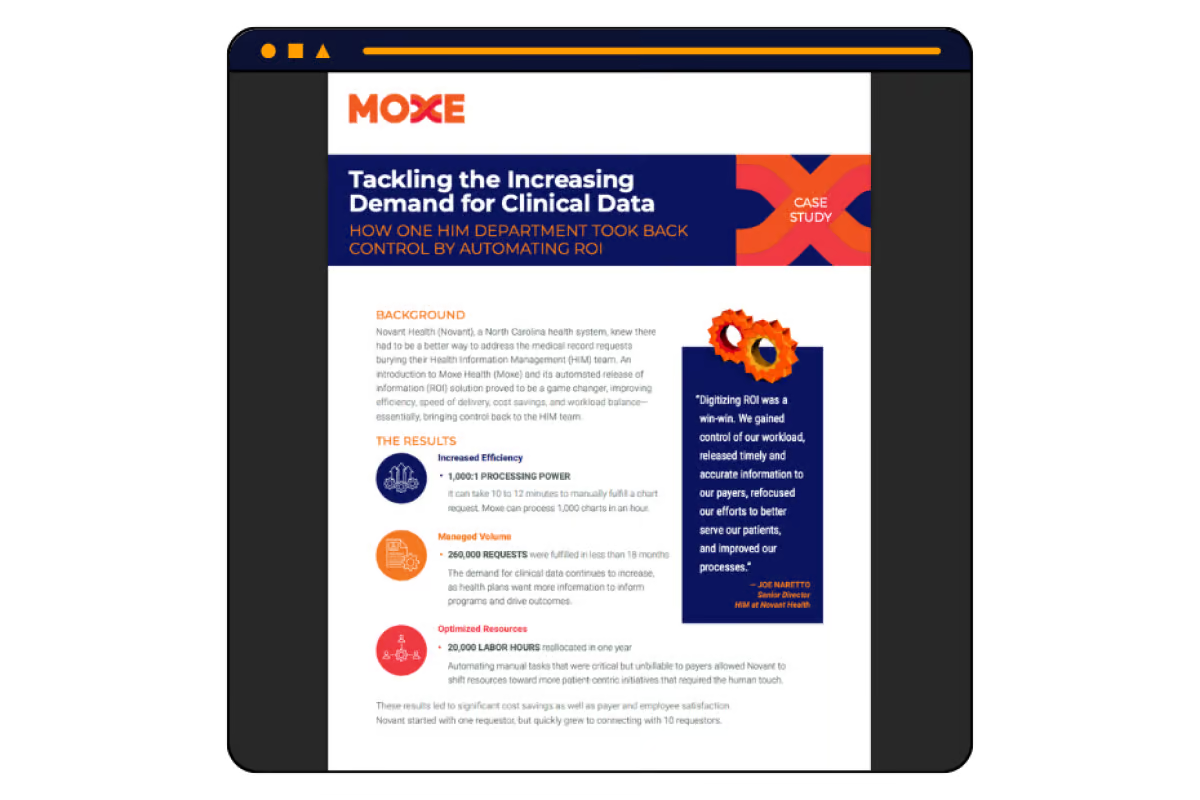
Novant Health: Driving Operational Excellence
Novant Health transformed its administrative landscape by automating the Release of Information process, proving that digital transformation is as much about human impact as it is about data. By implementing an automated workflow, the organization achieved massive scalability, fulfilling over 260,000 requests in less than 18 months. This shift boosted processing power to an incredible 1,000 charts per hour—a task that previously drained 10–12 minutes per manual request.
The results go beyond speed; the transition saved 20,000 labor hours in a single year, empowering staff to move away from paperwork and back to patient-centric initiatives. Additionally, with a 98% patient match rate, Novant Health has virtually eliminated the friction of payer back-and-forth, ensuring data accuracy and departmental peace of mind.
The Regulatory Landscape: HIPAA, HITECH, and Beyond
Navigating these medical release of information requests is rarely as simple as following a single set of rules. Instead, it is a complex balancing act between a “federal floor” of privacy standards and a patchwork of state-specific ceilings. For both providers and payers, failing to harmonize these overlapping laws can lead to severe financial penalties, audit failures, and eroded patient trust.
HIPAA and HITECH: Establishing the "Federal Floor"
Think of the Health Insurance Portability and Accountability Act (HIPAA) as the baseline for all ROI activity. It establishes the fundamental “Right of Access,” ensuring that individuals can obtain their protected health information (PHI) with minimal friction. The HITECH Act later modernized these rules, expanding HIPAA’s reach to include Business Associates (the vendors and partners who handle data) and introducing tiered penalty structures for non-compliance.
- For Providers: HIPAA dictates the “clock” for record delivery (historically 30 days) and mandates that you provide records in the format requested by the patient if you are technically capable. It also restricts the fees you can charge, shifting the focus from profit-generation to cost-recovery.
- For Payers: While often viewed as recipients of data, payers are also “Covered Entities.” They must maintain rigorous ROI workflows to handle member requests for billing and claims data, ensuring that any third-party disclosure (such as for life insurance underwriting) is backed by a valid, specific authorization.
The 21st Century Cures Act: Eliminating "Information Blocking"
While HIPAA protects privacy, the 21st Century Cures Act focuses on data liquidity. This legislation introduced the concept of “Information Blocking”—any practice likely to interfere with, prevent, or materially discourage the access or exchange of electronic health information (EHI).
- For providers: The Cures Act effectively shortens the “acceptable” turnaround time. In a digital environment, waiting the full 30 days allowed by HIPAA might now be flagged as intentional information blocking if the records are readily available in an EHR. Providers must now proactively ensure that their portals and APIs are open to patient-designated apps.
- For payers: Payers are increasingly viewed as “actors” under these rules, especially when they act as health information networks. They are pressured to share claims and clinical data more transparently with other providers and the patients themselves to improve care coordination and reduce redundant testing.

TEFCA alone is not an interoperability strategy
With over 10,000 participants joining since late 2025, TEFCA’s growth is undeniable. But a network of networks, such as TEFCA, brings unique challenges—specifically regarding data trust and security.
In our latest blog, Mike Arce breaks down:
- The trust challenge: A look at how recent legislation is forcing a tighter definition of treatment, and key considerations before joining TEFCA
- Stability vs. innovation: How TEFCA and CMS-aligned networks complement each other and why they both have a place to accelerate interoperability.
- The firewall factor: Why you still need a trusted, neutral partner to control data flow.
Don’t let your data strategy become a black box.
State Law Preemption: Navigating the Stricter Standard
The most challenging aspect of release of information services is “preemption analysis.” Under federal law, if a state law is “more stringent”—meaning it provides greater privacy protection or grants the patient more rights—it supersedes HIPAA.
- Sensitive categories: Many states have specific statutes regarding the release of “sensitive” information, such as HIV/AIDS status, mental health records, or substance use disorder (SUD) treatment. A standard HIPAA authorization might be insufficient in these cases, requiring a state-specific consent form.
- Shorter deadlines: While HIPAA allows 30 days, some states (like California or Texas) have historically mandated shorter windows for certain types of requests. Providers and payers operating across state lines must build “smart” workflows that automatically trigger the shortest applicable deadline based on the patient’s residency.
- Fee disputes: State laws often set specific per-page caps on what can be charged to third parties (like attorneys). Discrepancies between federal “cost-based” limits for patients and state “per-page” limits for third parties are a frequent source of litigation and administrative headaches.
ROI for Healthcare Systems: In-House vs. Outsourced
As the volume of medical record requests continues to rise, driven by increased payer audits, legal discovery, and patient-directed requests, health systems are at a crossroads. The choice between managing Release of Information (ROI) internally or partnering with a specialized vendor is no longer just an administrative decision; it is a strategic one that impacts financial health and organizational risk.
In-House ROI Management: A Traditional Approach
Managing ROI in-house involves using your existing Health Information Management (HIM) staff to intake, verify, and fulfill every request.
The Challenges:
- Fixed overhead: Unlike a variable-cost model, in-house ROI requires a constant investment in salaries, benefits, and office space, regardless of whether request volume is high or low.
- Direct liability: Your organization remains 100% responsible for any breach or compliance error. In an era of $1M+ HIPAA settlements, the “cost of a mistake” can be catastrophic.
- Staff burnout: HIM professionals are increasingly overtasked. When they are bogged down by the “invisible work” of manual retrieval and status-check phone calls, it leads to turnover and backlogs.
The Moxe Advantage: Expert ROI Specialists
Partnering with Moxe means transitioning from a fixed-cost burden to a scalable, expert-led solution. Our specialists act as a seamless extension of your HIM team.
Key Benefits:
- 100% US-Based Operations: Every Moxe ROI Specialist is located within the United States. This ensures patient data never leaves the country, maintaining the highest level of domestic security.
- Compliance-First Expertise: Every specialist is rigorously trained and kept up-to-date on evolving state and federal regulations, shifting the burden of compliance monitoring from your staff to our experts.
- Complete process transparency: Your team retains full visibility into every request submitted and processed with near-real-time dashboard reporting. You see exactly what we see, ensuring accountability at every step.
Navigating the Risks of External Partnerships
Not all outsourcing models are created equal. It is critical to understand how you will work with a vendor. A black box service can leave you in the dark regarding your own data. While outsourcing offers immense value, it carries specific risks if the vendor is not properly vetted:
- Offshore Data Access: Some vendors lower costs by using offshore labor. This can introduce significant security risks, as U.S. regulators have limited jurisdiction over foreign entities, and some state Medicaid contracts strictly prohibit data from being accessed outside the United States.
- Contractual “Lock-In”: Beware of vendors that quietly lock your data into proprietary formats or charge prohibitive “data export” fees, making it difficult to transition if the service no longer meets your needs.
- Automatic Renewals: Ensure your contract doesn’t include aggressive “evergreen” clauses that trap you into long-term commitments without performance benchmarks.
- Choice of Control: Will the vendor allow you to segment which requests they handle (e.g., only payer audits) while you keep others (e.g., patient requests) in-house?
- Process Visibility: Do you have a real-time dashboard to see exactly where a request stands, or do you have to call the vendor for an update? High-performing partnerships are built on radical transparency and shared workflows.

Is your ROI partner a help or a hindrance?
Is your Release of Information (ROI) program truly optimized for the digital age, or is it just getting by? As the demand for clinical data reaches an all-time high, healthcare organizations must move beyond manual workflows to balance efficiency with strict compliance and security.
This whitepaper from Moxe Health breaks down the 7 critical questions every leader should ask to evaluate their ROI strategy—from ensuring “minimum necessary” data exchange to leveraging automation that can process thousands of charts in minutes.
Discover how you can eliminate administrative bottlenecks, improve payer relations, and future-proof your data exchange processes.
Frequently Asked Questions: Medical Release of Information
Release of Information is the process of providing access to protected health information (PHI) to authorized individuals or entities. This process is strictly governed by HIPAA and state laws to ensure that patient privacy is maintained while allowing for the necessary flow of data for treatment, payment, and legal purposes.
Under the HIPAA Privacy Rule, providers must respond to a request for records within 30 calendar days. However, many state laws require a faster turnaround (often 15 days), and the 21st Century Cures Act encourages “immediate” access via digital portals to avoid “information blocking” penalties.
Yes, but charges are strictly regulated. Providers can charge a “reasonable, cost-based fee” that covers the labor for copying, supplies (paper or digital media), and postage. You cannot charge a “search and retrieval” fee for patients requesting their own records under federal law.
Many healthcare facilities partner with release of information services to mitigate the legal risk of a HIPAA breach and to reduce administrative burden. Professional vendors provide specialized technology, certified HIM experts (RHIA/RHIT), and faster turnaround times that most in-house departments cannot maintain.
Information blocking is any practice that is likely to interfere with, prevent, or materially discourage the access, exchange, or use of electronic health information (EHI). In the context of ROI, this means providers must not create unnecessary hurdles for patients or other providers trying to access digital records.


2026 Best in KLAS Payer-Provider Data Exchange
See why Moxe was given the top spot in this important category.