
Maximizing Interoperability
Why Moxe and Epic Payer Platform are Better Together
As technology advances, payers and providers must come together to develop a mutually beneficial clinical data exchange strategy. Interoperability is no longer nice to have. It is a core operational requirement for many health systems as they create a robust data exchange strategy. It isn’t about choosing one tool, it’s about building a complementary and complete toolkit.
A common question we hear is how Moxe fits into a stack that already includes the Epic Payer Platform (EPP). Far from being an “either/or” choice, these two solutions often work side-by-side to create a more resilient, transparent, and efficient data exchange environment.
Here is why a hybrid approach is becoming the gold standard for both providers and payers.
Expanded reach: Beyond the payer
In a complex healthcare ecosystem, data requests don’t just come from the health plans themselves. Providers are frequently inundated with requests from third-party requestors and specialized vendors working on behalf of those payers.
This is where a hybrid strategy becomes a necessity rather than a luxury:
- EPP focus: The Epic Payer Platform is a powerful, direct bridge specifically designed for health plans. It facilitates the Epic-to-Payer relationship for large payers but is generally limited to that direct connection.
- Moxe’s network: Moxe’s platform extends your reach to the entire ecosystem. It is available to both health plans and essential third-party partners.
By utilizing Moxe alongside EPP, providers ensure they aren’t forced back into manual, fax-based workflows when a third-party vendor, rather than the payer itself, needs to retrieve clinical documentation for risk adjustment or quality audits. This creates a single, automated path for all authorized requestors, regardless of their status as a plan or a partner.

Optimizing IT resources
Interoperability shouldn’t be a constant drain on IT teams. A hybrid strategy allows systems to leverage the native strengths of Epic for clinical workflows while using Moxe’s white-glove service for custom data requests.
Because Moxe manages the rules, updates, and requestor approvals on the provider’s behalf, it significantly lowers the technical burden. This light IT lift ensures that even as data sharing scales, the administrative work for the hospital’s tech team stays manageable.
Radical transparency and control
For providers, data exchange is about more than just sending files, it’s about stewardship. Working with a neutral partner like Moxe provides a layer of granular control and reporting.
- Visibility: Providers can see exactly who is requesting data and what was shared in near real-time with our dashboard reporting.
- Customization: Systems can set specific rules for different requestors, ensuring they share only what is necessary for a specific use case.
The bottom line: A better experience for all
When these platforms work in tandem, the entire ecosystem wins:
- For Payers: They receive high-quality, formatted data from the entire provider network (not just the Epic sites), leading to faster claims processing and more accurate risk assessments.
- For Providers: They reduce manual chart pulls, protect their IT resources, and maintain a high level of control over their data destiny.
In the end, the goal of interoperability is to make data accessible to improve patient care. By using a comprehensive hybrid approach, health systems are ensuring that no piece of the clinical puzzle is left behind.
Better Together: Why Moxe + EPP is a Game Changer
As the Chief Customer Officer for Moxe Health, I have a front-row seat to the transformation that happens when providers bridge the gap between clinical data and administrative efficiency. While each tool is powerful on its own, the real magic happens when you use Moxe and EPP in tandem.
Here is how our providers are winning with this combined approach:
- Peak performance on Value-Based Care: With both solutions in place, organizations can focus on optimizing the performance of complex VBC agreements. This includes streamlining high-touch programs like Optum’s In-Office Assessment (IOA), ensuring that quality gaps are closed without the usual administrative friction.
- Universal request coverage: Let’s face it, not all payers and records requestors have access to EPP. However, they still need critical clinical data. Moxe is their universal adapter, seamlessly automating data delivery to those payers and requestors who sit outside the EPP ecosystem, ensuring no partner is left in the dark.
- The end of manual requests: This is the “holy grail” for most HIM departments we work with today. When these two solutions work together, they are seeing the constant barrage of manual payer requests for information drop to virtually zero.
By integrating these workflows, we’re not just moving data for our customers; we’re giving clinical teams their time back so they can focus on what actually matters: the patient.
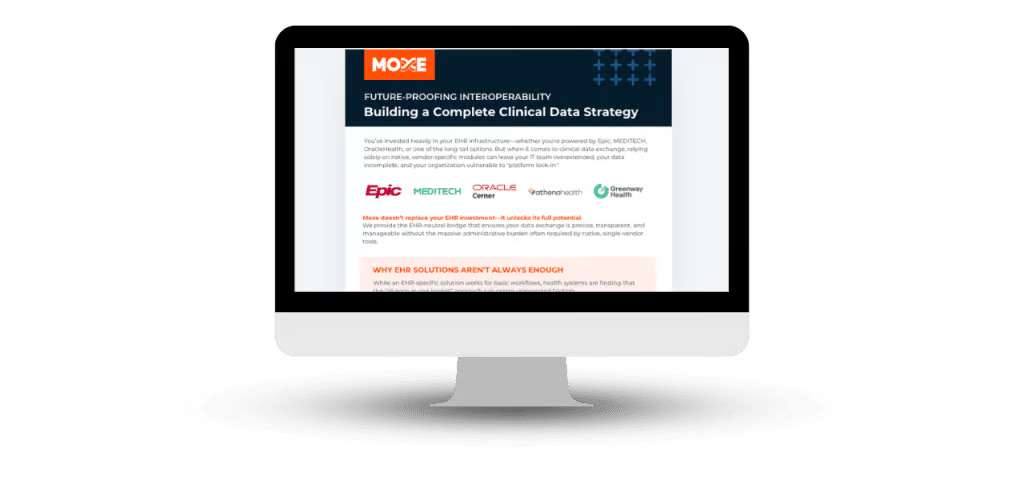
Ready to complete your clinical data strategy?
Don’t let “platform lock-in” or EHR blind spots limit your interoperability strategy. While your EHR is a powerhouse, a truly resilient network requires an EHR-neutral bridge to connect the gaps.
Download our guide, “Building a Complete Clinical Data Strategy,” to learn how to:
- Eliminate the EHR blind spot: Seamlessly share data from affiliated clinics using Oracle, MEDITECH, Greenway, athenahealth, and more.
- Reduce IT strain: Implement a FHIR-enabled solution in less than 20 hours and offload the burden of managing rules and updates.
- Gain radical transparency: Use real-time dashboards to track exactly what was shared, when, and why.
- Protect your revenue: Ensure data is formatted specifically for payers and HEDIS vendors to accurately reflect your quality measures.